
Kerala style interior design
what it actually means, and how to live in it- Kerala style interior design is not a decorative theme. It is a set of spatial and material principles developed over centuries to handle a specific tropical climate, material landscape, and way of living.
- The four pillars are: timber as the primary structural and decorative vocabulary, Athangudi tiles as a floor system (not an accent), courtyard logic for ventilation and light, and natural light management as a design material.
- Authentic execution starts with the plan and the light condition of the space. Material decisions follow. The palette emerges from the materials themselves: red oxide, teak gold, lime white, laterite grey.
- For a 2,000 to 2,500 sqft home using a selective Kerala palette, budgets start from ₹22 lakh for standard execution and from ₹28 lakh for premium-grade materials with complex joinery and full Athangudi tile work.
There is a version of Kerala interior design that belongs in a heritage hotel. Carved wooden pillars, bronze oil lamps, a courtyard open to the sky, handwoven silk cushions on a teak takhat. Atmospheric. Photographable. Deeply impractical for a 1,800 sqft apartment in Kowdiar with two working parents and a school-going child.
Then there is another version: the apartment that "has Kerala elements," which means a few Athangudi tiles stuck to one kitchen backsplash wall, a brass pot near the entryway, and terracotta-painted accent panels that were obviously done by a painter who looked at a mood board for twelve seconds.
Neither of these is what Kerala style interior design actually is.
The real thing is a set of building and spatial principles developed over centuries to deal with a specific climate, a specific material landscape, and a specific understanding of how families live together. When you understand what those principles are and why they exist, applying them to a modern home becomes a craft decision, not a theme decision.
- Timber vocabulary — teak and rosewood as structural and joinery material, not decorative add-on
- Athangudi tile as a floor system — full rooms and sequences, not a single accent wall
- Courtyard logic — airflow and diffuse light management as spatial intelligence, not open-sky aesthetics
- Light as material — indirect, filtered, directional; the palette only works when the light condition is right
The four pillars of authentic Kerala interior design
Timber as the primary structural and decorative vocabulary
In traditional Kerala homes, teak and rosewood were not decorative choices. They were structural ones. Teak in particular, valued for its density, natural oil content, and resistance to moisture and insects, was used for door frames, window frames, floor joists, roof beams, and ceiling panels. The joinery was not ornamental in origin: it evolved because wood was available, skilled carpenters were abundant, and the climate required materials that could breathe and flex without cracking.
In a modern interior context, Burma teak for full joinery runs from ₹2,500 to ₹4,000 per sqft installed. Plantation teak sits at ₹800 to ₹1,500 per sqft. These are not materials you use everywhere. They are materials you use in the right places, with intention: a window-seat with teak joinery, a ceiling panel in one room, a rosewood console at the entry. The budget follows the priority, not the other way around.
Athangudi tiles: a system, not an accent
Athangudi tiles come from a single village in Tamil Nadu, but they appear across traditional Kerala homes because of trade routes and shared craft traditions along the Coromandel coast. They are handmade cement tiles, each pressed individually, pigmented with oxide dyes, and finished without a kiln. The result is a mat, slightly porous surface that responds to light differently from any glazed ceramic.
The mistake is treating Athangudi tiles as decorative accents. They are designed to be used as a floor system, covering a full room or a sequence of rooms. Installed cost runs ₹300 to ₹600 per sqft depending on pattern complexity and subfloor preparation. Used in a kitchen as one backsplash wall, they look self-conscious. Used as the entire kitchen and dining floor, extending into a corridor, they anchor the entire home.
A single Athangudi backsplash wall in a contemporary kitchen. The tiles read as decoration applied to a space that has no other Kerala logic — and they look exactly as out-of-place as they are.
Athangudi as the full kitchen and dining floor, continuing into the corridor. The pattern creates a material narrative across connected spaces — this is how the tiles were designed to be read.
Courtyard logic: climate before aesthetics
The traditional Kerala home was organised around a nadumuttam, the central courtyard open to the sky. This was not primarily a design choice. It was a ventilation and cooling system. Air heated by the sun rose through the open shaft, drawing cooler air in from the lower spaces around it. The courtyard also brought diffuse natural light deep into the plan without exposing interior spaces to direct sun.
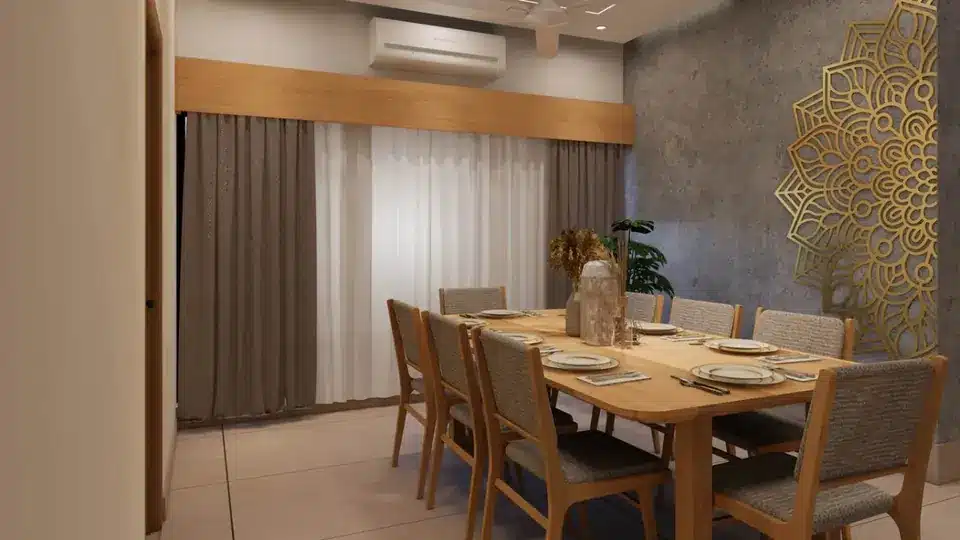
In a modern apartment or flat, a full nadumuttam is impossible. But the logic can be applied. A double-height space with a skylight in a villa. A light well in an apartment plan. An interior room given borrowed light through a clerestory panel above an internal partition. The point is that Kerala spatial intelligence is about airflow and light management, not about having an open sky in the living room.
Natural light as a design material
Kerala vernacular design used deep verandahs, overhanging roofs, and narrow window openings precisely to manage the high-sun intensity of a coastal tropical climate. Interior spaces received indirect, filtered light, which is why traditional teak and stone interiors feel calm rather than bright.
Recreating this in a modern home means working with the existing orientation first, before choosing materials. South-facing openings in Trivandrum need shading. East-facing rooms are appropriate for bedrooms that want early morning light. Materials like polished Natural Black granite (₹150 to ₹250 per sqft), red oxide floor finishes (₹60 to ₹120 per sqft), and lime plaster walls (₹80 to ₹150 per sqft) all look different under direct versus indirect light. The palette only works when the light condition is right.
Material rates and budget figures on this page were last reviewed in September 2026.
Real materials, real costs
A Kerala style interior project uses a specific set of materials. What follows is a working reference for Trivandrum and surrounding areas as of 2026.
| Material | Specification | Installed cost |
|---|---|---|
| Teak joinery (plantation) | Doors, window frames, cabinetry, ceiling panels | ₹800 to ₹1,500/sqft |
| Teak joinery (Burma) | Feature elements, entrance, primary bedroom | ₹2,500 to ₹4,000/sqft |
| Athangudi tiles | ₹180 to ₹350 per tile (6"x6") | ₹300 to ₹600/sqft |
| Kadappa limestone | Flooring, steps, feature walls | ₹120 to ₹200/sqft |
| Natural Black granite | Flooring in living, dining, corridors | ₹150 to ₹250/sqft |
| Laterite stone | Exterior, semi-covered areas (not wet areas) | ₹120 to ₹180/sqft |
| Lime plaster | Bedrooms, quiet spaces, main living walls | ₹80 to ₹150/sqft |
| Red oxide flooring | Service areas, corridors, covered outdoor | ₹60 to ₹120/sqft |
| Teak lattice and jali screens | Privacy screens, room dividers, shutters | ₹800 to ₹1,800/sqft |
| Bamboo ceiling panels | Covered outdoor, verandahs, study spaces | ₹200 to ₹450/sqft |
For a 2,000 to 2,500 sqft residential interior using a selective Kerala palette, budgets start from ₹22 lakh for standard execution and from ₹28 lakh for premium-grade materials with complex joinery and Athangudi tile work throughout. Use the Rzianz Interior Design Cost Calculator to explore a scope-specific estimate.
"The mistake is treating Kerala style as a costume you put on a room. A few wooden arches, some Athangudi tile accents, an oil lamp in the corner. The room is still fundamentally a contemporary box, and the Kerala elements sit on top of it like stage props." Rzian Homez
How Rzianz interprets Kerala style for modern living
The brief Rzianz receives most often is: "I want a Kerala feel but I also need it to function as a proper home."
This is not a contradiction. It is a design brief.
The Rzianz approach starts with the plan and the light. What is the orientation of the apartment or villa? Which spaces receive natural light, and at what times? How are the circulation paths organised? Can the kitchen, dining, and living sequence echo the progression from public to private that characterised traditional Kerala homes?
Material decisions follow spatial decisions. Teak is used where it earns its cost: at the entrance, in the main living space, in the primary bedroom. Athangudi tiles are used as a floor system in at least two connected spaces so they read as architecture, not decoration. Lime plaster is used in bedrooms and quiet spaces where the mat, breathing quality of the finish changes how the room feels. Kadappa stone or polished laterite is used in service areas and corridors.
Every material decision is made in sequence: plan and orientation first, then spatial structure, then primary floor material, then wall finish, then joinery, then hardware. Colour is last — because by the time you reach it, the palette has already been decided by the materials themselves.
Modern amenities, including fitted kitchens, contemporary bathrooms, climate systems, and integrated lighting, are treated as infrastructure: competently designed, well-detailed, but not the visual story of the home. A contemporary modular kitchen with teak-finished shutters and Athangudi tile flooring is not a compromise. It is an edit.
Browse completed Rzianz projects in the Kerala style interiors portfolio to see how these decisions translate to finished spaces.
The earthy palette: colour as identity
The Kerala interior palette is specific. Red oxide floors, terracotta-washed walls, deep green joinery, raw umber beams, natural stone in grey and black. These are not trendy colours. They are material colours: the colour the thing is, not the colour it was painted.
When a project replaces this with off-white walls and a few terracotta pots, it replaces the identity with a gesture toward it. The result is a room that could be anywhere, with a few objects that suggest somewhere.
It is not terracotta paint on feature walls. It is not a brass pot near the entryway. It is not Jaipur block-print cushions sold as "earthy." The palette emerges from material choices: the red of oxide floors, the gold-brown of teak grain, the grey of Kadappa stone, the off-white of drying lime plaster. These are not colour decisions. They are material realities that create a palette as a side effect.
Working with the palette properly means accepting that the colour comes from the material selections first. Red oxide floors are a colour decision. Lime-washed walls in their natural off-white are a colour decision. Teak in its golden-brown tones is a colour decision. The paint colours, where paint is used at all, are chosen to connect these material tones, not to substitute for them.
Deep green as a joinery colour or upholstery accent. Natural jute and coir textiles for rugs and cushion covers. Brass hardware in antique finish rather than polished chrome. These are not add-ons. They are what the palette demands once the foundations are set.
Connecting with heritage while living comfortably
For NRI homeowners returning to Trivandrum or building for family members, the Kerala style interior carries weight beyond aesthetics. It is a way of anchoring a home to a specific cultural and geographic identity at a time when globalised apartment interiors could make any city interchangeable.
The teak grandfather's chair. The Athangudi tile floor that matches something half-remembered from a childhood visit to a relative's ancestral house. The smell of lime plaster drying in a room that faces east. These are emotional reference points, not decoration requirements.

Rzianz works with this as a brief, not around it. If there is an heirloom piece of furniture or a set of tiles saved from a demolished family home, those become the starting point for the palette and material selection, not items to accommodate awkwardly.
Comfort is not in tension with tradition here. A well-designed courtyard logic brings natural ventilation that reduces AC load. Lime plaster walls regulate humidity better than painted cement plaster. Teak joinery lasts decades without replacement. The traditional choices were made for comfort in the first place, in a climate that demanded exactly these responses.
Common mistakes in Kerala style interiors
- Using Athangudi tiles as a single accent wall They are a floor system. One backsplash wall of Athangudi in an otherwise contemporary kitchen is neither here nor there. It reads as indecision. Use them as a floor, across at least two connected spaces, or not at all.
- Choosing teak accents over teak structure A teak frame around a door in a painted MDF-dominant interior looks like a frame around nothing. Use teak where it has context: as part of a joinery system, not as an isolated accent.
- Ignoring the light condition Red oxide and Kadappa look extraordinary in indirect, filtered Kerala light. In a north-facing flat with limited natural light, the same palette can feel heavy and dark. Solve the light condition first. Material decisions follow.
- Over-furnishing with antiques A few genuinely old pieces sit better in a considered modern interior than a room where every surface carries a heritage object. Edit aggressively. Three objects with real presence outperform twelve that dilute each other.
- Treating the palette as optional If the material decisions are right, the palette arrives naturally. If the material decisions are contemporary and the palette is applied through wall paint and soft furnishings, the result is a costume, not a home.
Frequently asked questions
What is the cost of Athangudi tile flooring in Kerala?
Athangudi tiles are priced at ₹180 to ₹350 per tile (6"x6"). Installed cost including subfloor preparation and grouting ranges from ₹300 to ₹600 per sqft. For a 1,000 sqft application, budget from ₹3 lakh for materials and installation. Patterns with more colours and finer detail sit at the higher end of the range.
How long does a Kerala style interior project take?
A residential project covering 1,800 to 2,500 sqft typically takes 12 to 16 weeks from design sign-off to handover. Projects with complex teak joinery or custom Athangudi tile layouts add 2 to 3 weeks to the fabrication phase. The timeline assumes a completed structure handed over by the builder before Rzianz starts work.
Can Kerala style interiors work in an apartment?
Yes, with a different set of tools. The courtyard logic translates to light wells, clerestory panels, and carefully managed interior sightlines. Athangudi tile flooring, lime plaster walls, and teak joinery work in any space type. The full nadumuttam open-sky courtyard is the one element that requires a villa or independent home with the structural capacity to accommodate it.
Is teak flooring practical for a modern home?
Solid teak flooring requires maintenance: annual oiling, avoidance of excess moisture, and the expectation that it will mark and develop a patina over years of use. For homeowners who want a floor that improves with age and carries the history of the house, it is the right choice. Most Rzianz Kerala style projects use teak for joinery rather than full flooring, with Athangudi or natural stone as the primary floor.
What makes Kerala interior design different from South Indian interior design generally?
The specific material vocabulary: teak and rosewood rather than other hardwoods, Athangudi tiles from the Coromandel craft tradition, laterite stone, lime plaster, and the courtyard-centric spatial organisation. Kerala style is identifiable by the combination of all these elements, particularly the timber vocabulary, the nadumuttam spatial logic, and the earthy palette drawn from the laterite-and-forest landscape of the state.
How do I start a Kerala style interior project with Rzianz?
Start with a WhatsApp conversation. Describe your space (apartment or villa, approximate sqft, location in Trivandrum), your timeline, and the level of Kerala material commitment you are considering. A brief exploratory call follows. From there, Rzianz produces a preliminary scope with material options and a budget indication before any design fee is committed.
Tell us about your space. We will tell you what is possible.
Share your apartment or villa details, your timeline, and how much Kerala material commitment you are considering. We will send a preliminary scope before any design fee is discussed.
WhatsApp Rzianz