What a real tharavadu is, how it differs from a heritage-styled exterior, and what it costs to build one properly in 2026.
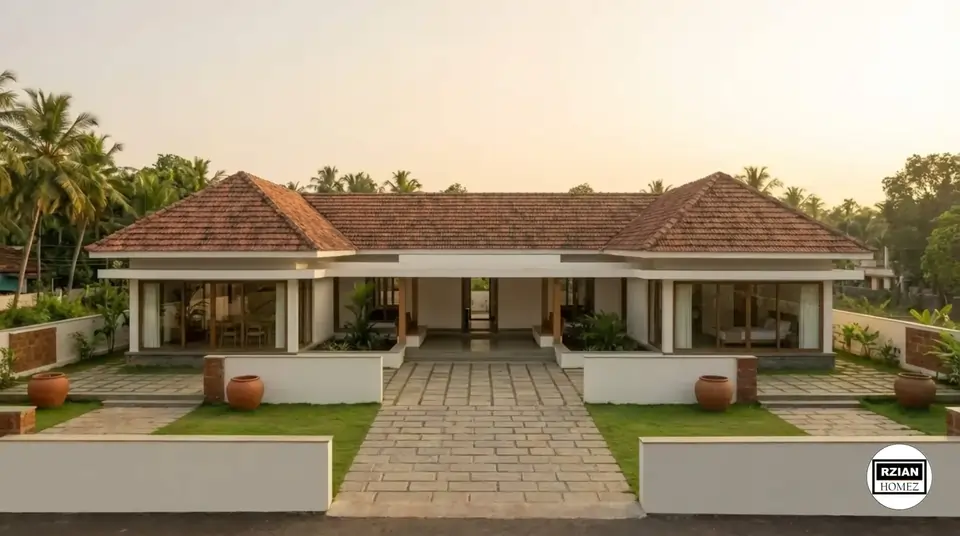
A tharavadu is a traditional Kerala ancestral home: the permanent, multi-generational family house built around a central open-to-sky courtyard called a nadumuttam. It is defined by a sloping Mangalorean-tile roof, teak pillars and doors, and charupadi verandah seating, with the whole plan laid out to Vastu principles.
The family had not visited in eleven years. When they finally opened the iron gate, the roofline was intact. The carved teak thulasi thara still stood. The laterite walls, two feet thick, had held every monsoon without a crack.
That house was built in 1932. The people who built it understood something most modern builders still do not: a tharavadu is not a house you build for yourself. It is a house you build for the three generations that come after you.
Many heritage-style homes from builders in Trivandrum stop at the surface: sloped roof tiles, a few wooden pillars at the entrance, Kerala-tile texture on the render. A real tharavadu is planned from the structure inward.
A real tharavadu is designed so the home functions as the family's permanent anchor for three generations. The proportions are deliberate. The nadumuttam breathes. The verandah is for sitting, not just for walking through. Every structural decision carries the weight of what comes after you.
This is for families who are serious about that inheritance. Not for buyers looking for a heritage-themed exterior on a standard plot.
Built to proper standards, OPC 53 cement, SAIL or JSW Fe-500 rebar, M-Sand throughout, M-30 slab concrete, so it does not settle or crack in Kerala's monsoon soil.
Proof Designed to IS 456:2000 for long structural life, with crack-control reinforcement at every opening and corrosion protection on all embedded steel.
On the day your grandchildren carry a new baby through the door, the house will not have shifted an inch.
A properly proportioned central courtyard, a minimum of 12 by 12 feet in a 2,000 sqft home, pulls light and air into every room it faces and keeps the inner rooms cooler through Trivandrum's April heat.
Proof A Rzianz tharavadu in Kazhakkoottam (2,400 sqft, 2023) ran 4 degrees below outside ambient at April peak, measured across five days.
The morning light through the nadumuttam is the reason your children will want to come back.
Full-house teak is a Rs. 40 to 60 lakh decision most families do not need. Rzianz anchors teak at the external doors, pillars, and thulasi thara, grading interior woodwork strategically.
Proof Teak external doors are 1.75 inches thick, Burmese or plantation-grade, with the supplier/manufacturer warranty as specified in the approved BOQ.
A visitor feels the weight of real teak in their hand, doing work no interior styling can replicate.
In a tharavadu, Vastu is structural, locked before the first column is placed, not a set of adjustments applied after the plan is drawn.
Proof Vastu is aligned during the initial site survey, and every plan is reviewed by a Vastu consultant before structural drawings issue. Revision cost at this stage: zero.
The elders will walk the site once and know, without asking, that it was built the right way.
NRI families fear the site they cannot see. Rzianz sends a WhatsApp video of every major milestone, from plinth pour to final walk-through, every week without being asked.
Proof 300-plus homes built across Kerala, most through referrals. Ask for a reference and we connect you to a past NRI client.
You will watch your tharavadu rise on your phone in Dubai, the way your grandfather watched his rise from the paddy field.
Every tharavadu begins with a brand-locked BOQ, every material and labour rate named and signed before ground breaks. The price holds unless you change the scope.
Proof Every BOQ names the supplier and grade: SAIL/JSW/Vizag steel, OPC 53 cement, M-Sand, Jaquar, Grohe, or Kohler plumbing, teak doors, and Mangalorean tile.
Your mother in Thiruvananthapuram will not receive a call asking for more money.
Ready to talk about your tharavadu?
No sales pitch. Just clarity on your plot and what it takes to build it properly.
Start the conversationThree failure patterns that appear repeatedly across Trivandrum and Thrissur builds.
The most common tharavadu failure is a hollow-block or unspecified-grade laterite wall, dressed in Mangalorean tile and wooden pillars. The exterior reads heritage. The build underneath is standard budget construction. Within 15 to 20 years, the walls show efflorescence, the tile ridge cracks, and the wooden elements rot at the joints because the substrate never had the structural rigidity to hold them.
Pattern seen across Kerala residential disputesA Vastu violation built into the structure cannot be fixed with copper plates and puja. It requires structural intervention. A family in Thrissur spent Rs. 4.2 lakh on post-construction Vastu corrections because their contractor said the alignment could be adjusted after the build. It could not. The corrections involved relocating a kitchen wall and rebuilding one section of the staircase.
Common pattern in contractor-led heritage buildsA family from Sharjah paid Rs. 22 lakh in advance to a Trivandrum contractor who showed them a completed tharavadu as his reference work. The project had not been built by him. He had photographed a client's completed home without permission. The family discovered this when they contacted the actual owner of that home.
Field observation from Kerala residential builds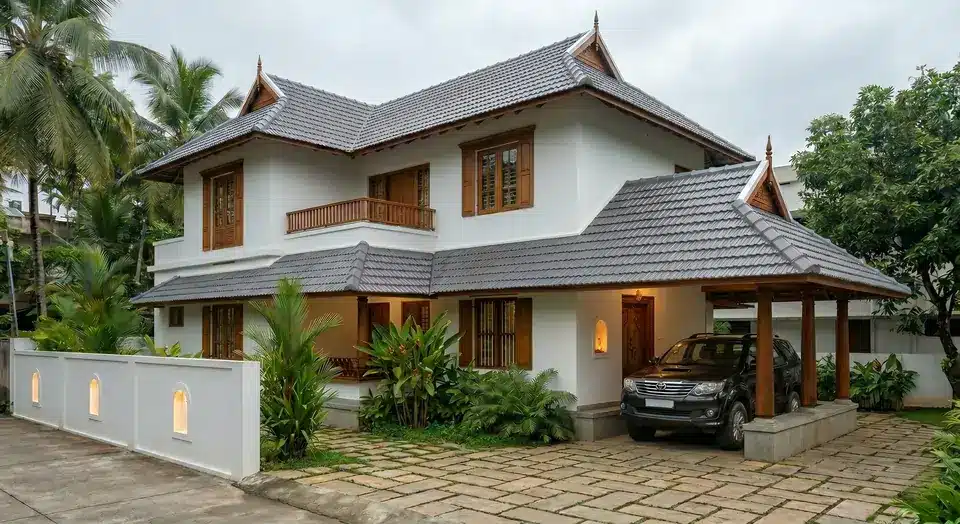
We visit the plot, read the soil, measure the orientation, and sit with the family for two hours. Not to sell. To understand which archetype fits your plot and how your family actually lives. Nalukettu, ettukettu, naduthara, or modern-traditional: the choice is yours, informed by the site.
Week 1The architect draws the plan. Structural engineer reviews simultaneously. Vastu locked before drawings are issued.
Every material and rate is named and signed. Price does not move unless you change the scope.
One video every week, without exception. Every major milestone, on your phone before you ask.
Your family receives a complete record of what was built and what it cost. Everything signed and filed.
A tharavadu is a Kerala ancestral home, traditionally a multi-generational family compound centred on a courtyard. The defining features are a sloping Mangalorean tile roof, teak woodwork, verandah seating, and a plan designed around Vastu. Unlike a standard Kerala house, it is designed to function as the family's permanent anchor property across three or four generations.
A nalukettu is the most common type of tharavadu: a square plan with four wings (naalu kettu) built around one central courtyard, the nadumuttam. The four halls face inward around the open-to-sky void, which handles light, ventilation, and rainwater. It is the archetype most families adapt for a new tharavadu today.
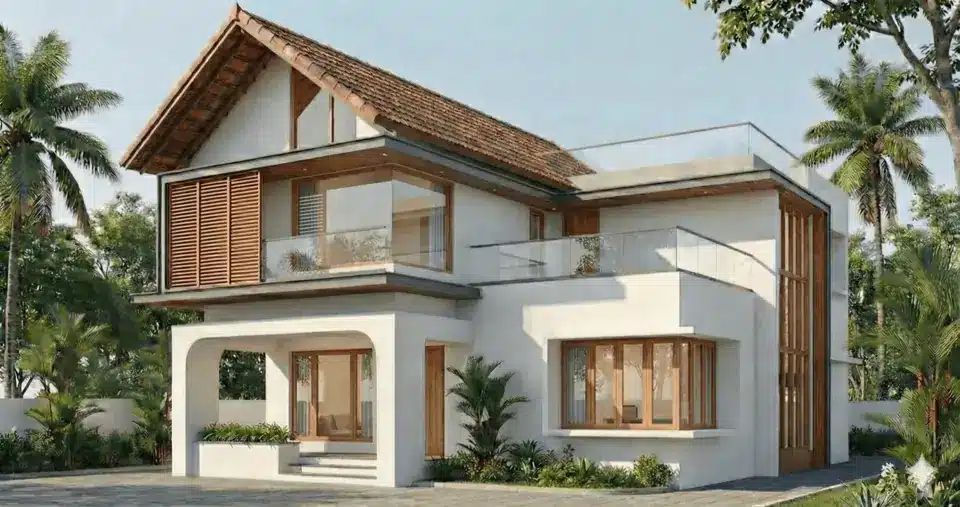
A modern tharavadu is a contemporary home that keeps the defining elements of the traditional ancestral house, the nadumuttam courtyard, sloping Mangalorean-tile roof, teak woodwork, and verandah, while adding current amenities and an efficient layout. Rzianz designs and builds these on the family's own land, laid out to Vastu from the first drawing.
Most families building today choose a nalukettu-inspired plan adapted to their plot, or a modern-traditional verandah home that preserves the key elements.
Four wings around one central courtyard. The most common choice for new builds today.
Eight wings, two courtyards. Larger footprint, suited to bigger plots.
Sixteen wings, four courtyards. Rare, typically of aristocratic origin.
Hall-forward single-storey plan without a full courtyard. Works on smaller plots.
A tharavadu-inspired home built to a proper standard - teak doors, Mangalorean tile, M-Sand, OPC 53 cement, SAIL Fe-500 steel, and Jaquar plumbing - costs from Rs. 80 lakh for 2,000 sqft in Trivandrum. The cost scales with archetype complexity. See our full Kerala construction cost breakdown for a detailed estimate.
Yes. A nalukettu-inspired plan can be adapted to plots as small as 5 cents. The nadumuttam is scaled accordingly: a 6 by 6 foot open-to-sky void still brings meaningful light and ventilation to the inner rooms. The sloped roof, teak pillars, and verandah can be retained on any standard residential plot. What changes with a smaller plot is wing depth, not architectural identity.
Only if it is designed that way from the first drawing. Traditional tharavadus were built by thachans who embedded Vastu into the proportions from the ground up. A modern tharavadu where Vastu corrections are made after the plan is drawn is not truly Vastu-compliant. Rzianz locks Vastu alignment in the design phase, before structural drawings are issued.
A 2,000 sqft tharavadu-inspired home on a clear site typically takes 14 to 18 months from foundation to handover. The additional time versus a flat-slab home comes from the roof structure (traditional sloped rafters and Mangalorean tile require more site time than a poured slab) and the teak woodwork (doors, pillars, and charupadi are made to measure).
Rzianz sends a WhatsApp video of every major milestone, from foundation pour to final walk-through, every week without being asked. The price is locked before the first stone is laid. You do not need to be in Kerala to protect your build. See the complete NRI home construction process.
Yes. The identity of a tharavadu is in its form, sloped roof, verandah, nadumuttam, teak doors, not in its services. All of these are fully compatible:
The exterior reads heritage. The interior lives modern.
A nalukettu is one specific archetype within the tharavadu family. It has four wings (kettu) around one central courtyard (nadumuttam), forming a square plan. Every nalukettu is a tharavadu. Not every tharavadu is a nalukettu. An ettukettu, a pathinaarukettu, or a naduthara-plan home can all be tharavadus without being nalukettus.
The maintenance costs are known and budgetable. The nasty surprises that hit standard builds after year 15, spalling concrete, chloride attack, UPVC warp, are largely absent in a well-built tharavadu.
Your tharavadu will be finished in 18 months. Your children will spend the next 50 years inside it.
They will carry their own children through the front door, sit on the charupadi in the evening, look into the nadumuttam in the morning.
The decision you make about how it is built, which builder, which BOQ, which frame, will be invisible on handover day. It will be completely visible in year 15.
Who are you building it for?
Two paths forward. Choose the one that fits where you are right now.
Tell us your plot location, family size, and which archetype interests you. No sales call. Just clarity.
Start on WhatsApp Need a number first?See what a tharavadu-inspired home may realistically cost on your plot in Trivandrum before you move ahead.
Open Cost Calculator →