
11 Costly Mistakes to Avoid When Building a Home in Kerala (2026)
Reviewing a contractor's quote right now? A Rzianz architect will check it for hidden gaps, free, before you sign.
Free quote check →Key takeaway
- You got a quote, negotiated it and signed it. Somewhere between the foundation and the final coat of paint the budget still grew, and every extra was valid under the contract. The problem was rarely the homeowner's diligence. It was that construction started before the project was defined on paper.
- Kerala home budgets overshoot in a predictable sequence, and most of it is avoidable if it is caught before the first brick is laid. This guide lists eleven mistakes, what each one does to your cost and programme, and what to check before you sign.

No documented design brief before construction begins
What it is. "I want an open-plan kitchen." "The master bedroom should feel spacious." These are not specifications. Without a written brief that sets room sizes, functions, circulation priorities and material standards, every decision on site is made on the builder's reading of what you meant.
What it costs. A wall moved after brickwork is complete means demolition, rebuilding, re-plastering and a delay for every trade behind it. Late layout changes are paid for twice: once to build the wrong thing and once to correct it.
How to avoid it. Write the brief down before design starts: room-by-room sizes and functions, circulation priorities, storage per room, which rooms should get morning light, and future needs. If you intend to add a floor later, say so now. The foundation, columns and beams have to be sized for that load at the design stage. Adding capacity to a built and occupied house is far harder and far more expensive.
Starting construction without approved structural drawings
What it is. Construction begins on an architectural plan, or sometimes a rough sketch. Then the structural engineer reviews the columns and finds the foundation has to be redesigned to carry the upper floor. The architectural plan shows rooms and how the house looks. The structural drawing shows how load is carried: column sizes, beam depths, reinforcement and the foundation type for your soil. Many contractors start on the first document and treat the second as paperwork.
What it costs. Foundation rectification can involve major additional cost and programme delay once construction has started. Work already poured may have to be broken out, and every trade behind the structure waits while it is redone.
How to avoid it. Four documents must exist and be cross-checked before any earthwork: architectural plan, structural drawing stamped by a licensed structural engineer, MEP layout and soil investigation report. At Rzian Homez, construction does not mobilise until all four are signed off.
Skipping the soil investigation
What it is. Kerala soil is not uniform. Laterite, clay, alluvial deposits near water bodies and loose or filled ground near the coast all occur, and each needs a different foundation. Much residential construction in Kerala still starts without a soil test because the contractor "knows the area". Contractors skip it partly because it is cheap enough to feel optional and partly because it creates a document that holds them accountable for the foundation design.
What it costs. If the ground under part of the house is weaker than assumed, the foundation is under-designed for it and the problem shows as settlement and cracking after handover. Correcting a foundation under a finished house is disruptive and expensive.
How to avoid it. Make appropriate soil investigation a written condition of the contract: no report, no foundation work. The scope of soil investigation should be determined for the specific site by the geotechnical/structural professional, taking account of ground conditions, filling, slope, groundwater and the proposed structure. A Standard Penetration Test is one of the investigation methods that professional may specify. The report should state the bearing capacity at foundation level and the water table depth, and the foundation should be designed from it.
Choosing a contractor on per-square-foot rate or lowest quote alone
What it is. A per-square-foot rate sounds precise. In practice it is a marketing figure built to win the comparison against other contractors. A builder prices low enough to win, then recovers margin through variation claims once you are committed. The rate typically covers basic structure and finishing only. It leaves out the compound wall, overhead water tank, septic tank, site levelling, external drainage, plumbing fixtures, flooring upgrades and kitchen cabinets. Each becomes an "extra" after work begins, and every one of them is valid under the contract you signed.
What it costs. The excluded items are the difference between the rate you compared and the total you eventually pay. The hidden-costs guide walks through the line items a per-square-foot quote usually leaves out.
How to avoid it. Compare contractors on total project cost against an identical scope. Ask every contractor to price the same Bill of Quantities, with materials named at brand and grade level: not "quality tiles" but a named tile with its size, finish and grade; not "good fittings" but "Jaquar, Grohe or Kohler throughout". Ask what is excluded, in writing. For what a complete quote should cover, see house construction cost in Kerala or run the home cost calculator.
Building without a BOQ
What it is. A contractor gives you a quote and construction begins. Some months in, the flooring "was not included". The concealed AC trunking is extra. A verbal quote or a one-line estimate contains no agreement on materials, quality grade or scope. Without a Bill of Quantities listing every item with its specification, quantity and unit rate, you have no baseline to challenge an extra against.
What it costs. An incomplete BOQ makes final cost difficult to control because exclusions, quantities, specifications and change orders are not fixed clearly enough.
How to avoid it. Insist on a full BOQ before signing, detailed enough that a second contractor could price it without asking a single clarification. Check that it names materials by brand and grade, states quantities and lists exclusions. If you already have one, a Rzian Homez architect will check it line by line through the free BOQ audit.
Treating KMBR approval as a formality
What it is. The Kerala Municipal Building Rules, and the Panchayat Building Rules outside municipal limits, govern setbacks, floor area ratio, building height, staircase widths and the other parameters that decide what you can actually build on your plot. Many homeowners get the plan approved, then build what they wanted anyway: closer to the boundary than the approved setback, an extra floor, a garage converted to a room.
What it costs. The discrepancy surfaces when you sell, apply for a completion certificate or a loan, or when the local body conducts a survey. Where regularisation is possible, it comes with fees and legal costs. Where it is not, the non-compliant portion is demolished at your own expense.
How to avoid it. Design for compliance from the start, and write into the contract that the approved drawings and the executed building must match. Any change after approval goes through an amended approval before it is built.
No stage-wise payment structure
What it is. Either the contractor asks for lump sums whenever cash flow demands it, or the homeowner withholds payment until completion and the contractor cuts material quality to stay afloat. Even where the split is fixed, the triggers are vague: "on completion of foundation", "on reaching roof level". The builder calls a milestone complete, you pay, and then you find items under that milestone were not done.
What it costs. Payment disputes stop work. When a site stops, the homeowner carries the rent, the loan interest and the material price increases in the gap. A programme of 270 days only holds if the money and the work move together.
How to avoid it. Tie every payment to a physically verifiable state on site, released only after your architect or project manager confirms it. The Rzian Homez schedule runs in stages, each with a site condition that has to exist before payment is released:
- Agreement: contract signed, scope locked, timeline confirmed
- Start of construction: excavation complete, foundation work begins
- Plinth: foundation complete, damp-proof course laid, plinth beams cast and cured
- Ground floor slab: poured, cured, shuttering removed
- First floor slab: poured and cured
- Plastering: external plaster done, internal rough plaster complete
- Tiling: all floor and wall tiling complete, joinery fixed
- Completion: electrical and plumbing final fix, painting done, keys handed over
No payment is triggered by a date, a phone call or a verbal update.
Poor-quality materials in the elements you never see
What it is. The parts poured into walls and slabs and never seen again decide how long the building lasts. Cheaper or adulterated cement is sometimes introduced mid-project without the homeowner knowing, and substandard steel does not fail on day one. The effect shows up as cracking and deflection years later.
What it costs. If structural concrete is found to be under strength, the remedial options run from strengthening the affected members to demolishing and rebuilding them. Both are far more expensive than the testing and supervision that would have caught the problem at pour time.
How to avoid it. Specify in the BOQ and verify on site:
- Cement: grade and IS standard named in the BOQ, with the manufacturer's test certificate for every batch.
- Steel: grade and IS standard named in the BOQ. Check that bar markings on every bundle match the certificate batch numbers.
- Sand: M-Sand or P-Sand, named in the BOQ.
- Bricks: red clay bricks from genuine kilns, with strength and water absorption to the BOQ specification.
- Concrete: cast test cubes at pour time, test them at the age the standard specifies, and keep the results.
- Delivery challans for every batch of cement and steel, cross-checked against BOQ quantities.
Waterproofing at the wrong stage
What it is. Kerala gets months of monsoon rain and stays humid the rest of the year. The right time to waterproof is during construction, before concrete is poured and before surfaces are finished. The wrong time is after the building is complete, as a repair, which means opening screeds, lifting tiles and reapplying membranes from the inside.
What it costs. Dampness remediation on a completed home is the most expensive remediation we see, because every rupee goes into surfaces that were already finished once. Monsoon exposure also drives sequencing: a slab left unprotected through a rain season is compromised before the house is occupied.
How to avoid it. Four locations are non-negotiable and belong in the BOQ as line items: the roof slab; bathroom wet areas; external retaining walls; and a plinth damp-proof course to stop capillary rise, each using the approved waterproofing system specified for the particular location and project, all done and tested before the finishes go on.
MEP routes finalised after plastering
What it is. MEP (mechanical, electrical, plumbing) is everything hidden inside your walls, slabs and ceilings. In a well-run project all routes are fixed on a coordinated drawing before any wall is plastered. In a poorly run one, the electrician arrives after plastering and starts cutting channels into finished walls, and you pay for the plasterer to come back.
What it costs. Every channel cut into a finished wall is paid for three times: the plaster that was applied, the cutting, and the plaster that replaces it, and the painter and tiler wait until the re-plaster has cured.
How to avoid it. Write the sequence into the contract: structure complete, MEP drawings finalised, MEP rough-in complete, then plaster. Every socket, switch, light point, pipe entry and AC location is marked before the plasterers arrive. Bring the interior designer in before construction finishes, because wardrobes, kitchen layout and concealed lighting points need construction-stage coordination.
Window and door frames chosen on upfront price alone
What it is. UPVC frames are cheaper than hardwood at the time of purchase, so a contractor working to a tight quote recommends them. The comparison is made on the invoice price, not on how the frames perform through Kerala's humidity, monsoon rain and sun exposure over the life of the house.
What it costs. A frame that has to be replaced is not a saving. Weighed against maintenance and replacement over the years you live in the house, the cheaper frame is not always the cheaper choice.
How to avoid it. Decide the frame material deliberately and write it into the BOQ. Hardwood windows and doors in teak, anjili or kadamb are available locally and have a long track record in this climate. If UPVC is chosen, it should be a whole-life-cost decision, with the brand, profile and hardware named in the BOQ.
The common thread
Every mistake above has the same root: construction begins before the project is fully defined on paper, with a builder whose incentives are not aligned with yours. An undefined scope is how extras get added legally, after you have signed.
Rzian Homez builds under a single design-build contract: the team that designs your home builds it, on a material-level BOQ, milestone-verified payments and a 270-day programme from groundbreaking to handover. For how this runs in the capital, see house construction in Trivandrum.
Before you sign: the checklist
- Written design brief with room sizes, functions and storage quantified
- Architectural plan, structural drawing stamped by a licensed structural engineer, MEP layout and soil investigation report, all cross-checked
- Building permit, title deed and encumbrance certificate in hand
- BOQ with every item specified by brand, grade and quantity, plus a written list of exclusions
- Cement, steel, sand and brick specifications, hardwood frames and Jaquar, Grohe or Kohler fittings named in the BOQ
- Waterproofing at roof, wet areas, retaining walls and plinth as BOQ line items
- Stage-wise payment schedule tied to physically verified milestones
- Contract clause: approved drawings and executed building must match
- MEP sequence written in: drawings, rough-in, then plaster
- 270-day programme with named site supervision
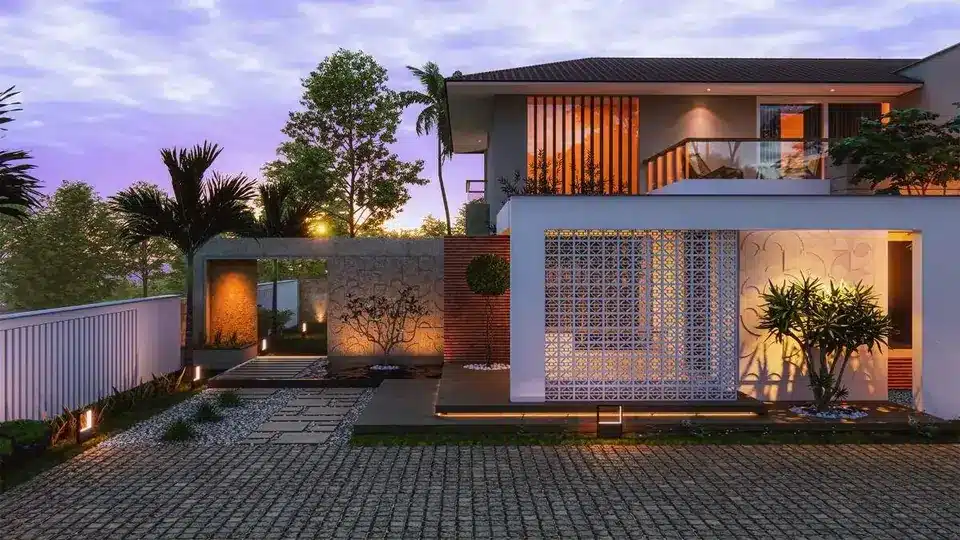
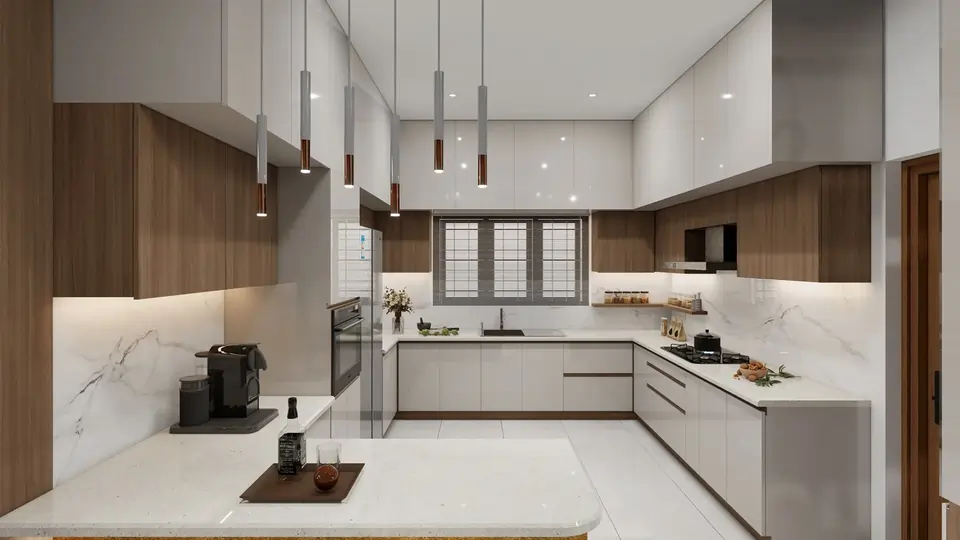
What a Well-Managed Kerala Build Looks Like
Every project below was completed with a full BOQ, structural drawings, soil test, and stage-wise payment schedule in place before the first brick was laid.


Frequently Asked Questions
What are the most common mistakes when building a home in Kerala?
Is UPVC good for windows in Kerala?
What is the right payment schedule for home construction in Kerala?
How do I verify that my builder is using the materials specified in the contract?
What should I do before signing a construction contract in Kerala?
Your contractor's quote has gaps. Find them before you sign.
A Rzianz architect will review your drawings, check your contractor's BOQ, and tell you what is missing before you are locked in. Free.
Get my free quote review on WhatsApp →